
In-House vs Outsourced Accounting and Bookkeeping:
In-House vs Outsourced Accounting and Bookkeeping:
What Canadian SME Owners Miss in the Cost Comparison
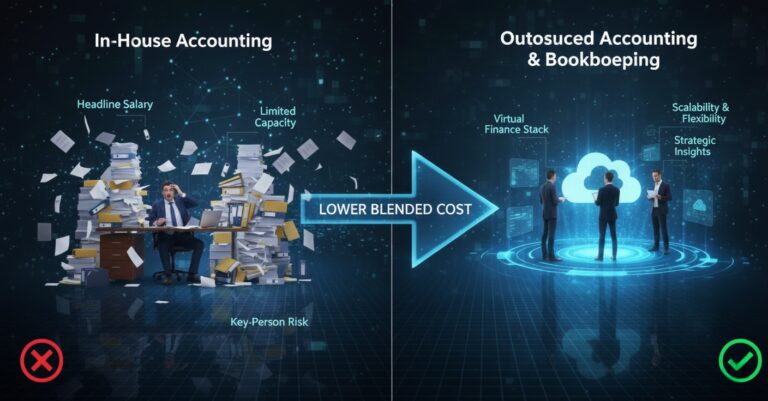
For many Canadian SME owners, the choice seems simple:
“Hire a bookkeeper or accountant in-house” vs “pay a firm for outsourced accounting and bookkeeping.”
On paper, an internal hire often looks cheaper. But once you factor in the full picture—costs, risk, and capability—the numbers tell a different story.
This article breaks down what is usually missed in the in-house vs outsourced accounting and bookkeeping comparison and why more SMEs are moving to a CFO-led outsourced accounting and bookkeeping model.
1. The “Headline Salary” Trap
Most owners compare:
- In-house: annual salary of a bookkeeper or accountant
- Outsourced: monthly fee for outsourced accounting services
What’s often missing:
- Employer CPP/EI contributions
- Benefits, vacation, and sick days
- Recruitment fees and onboarding time
- Training and software costs
- Management time spent supervising the role
When you add these, the true annual cost of an internal finance hire can be 20–30% higher than the salary line.
By contrast, outsourced accounting services for SMEs bundle these elements into a single, predictable fee.
2. One Person vs a Virtual Finance Stack
An in-house bookkeeper is one person. That usually means:
- Limited capacity at peak times
- Key-person risk if they leave or are off sick
- Gaps in higher-level skills (analysis, forecasting, cashflow)
A virtual finance stack in a CFO-led outsourced accounting model looks different:
- A bookkeeping team handling day-to-day entries and reconciliations
- A controller-level review ensuring accuracy and consistency
- A CFO-level resource interpreting results and advising on decisions
You are not just comparing “one internal person” with “one external person.” You are comparing one person with an integrated team.
For a deeper explanation of this structure, see outsourced accounting and bookkeeping for Canadian SMEs
3. Cost vs Capability
A fair comparison needs to ask:
“What level of capability do we actually need for a $1M–$10M SME?”
Most growing businesses need three layers:
- Bookkeeping – recording transactions, reconciliations, GST/HST
- Controllership – month-end close, reviews, basic controls
- CFO / FP&A – forecasting, scenario planning, decision support
An internal bookkeeper can handle layer 1.
Layers 2 and 3 are often either:
- Not done at all, or
- Done by the owner after hours, or
- Done expensively by external advisors on a one-off basis
A CFO-led outsourced accounting and bookkeeping model deliberately includes all three layers at a lower blended cost than hiring each internally.
4. Hidden Costs of an In-House Finance Function
Beyond direct cost, in-house finance carries hidden costs:
- Time cost – CEO and managers reviewing, correcting, or chasing numbers
- Quality risk – inconsistent month-end reporting, weak controls
- Scalability limits – outgrowing one person, but not ready for a full team
These show up as:
- Delayed decisions because numbers are late or unclear
- Surprises in cashflow and margins
- Extra work at year-end for your tax accountant or auditor
When SMEs move to outsourced accounting for Canadian SMEs, they often report:
- Faster month-end close
- Fewer surprises in cash and profitability
- Less time spent “fixing” finance issues internally
All of this contributes to reduce finance department costs in a broader sense—not only in dollars, but in leadership time and risk.
5. Flexibility as You Grow
In-house hires are fixed:
- If workload drops, you still carry the full cost
- If workload spikes, one person becomes a bottleneck
With outsourced bookkeeping services and a virtual finance team:
- You can scale up support when needed (e.g., rapid growth, acquisitions, system changes)
- You can scale down if the business contracts or stabilises
- You don’t need to manage recruitment, performance, or replacement
For SMEs in the $1M–$10M range, this flexibility can be the difference between a finance function that grows with the business and one that holds it back.
6. When Does Outsourcing Make Sense?
Outsourcing becomes compelling when:
- Revenue has passed ~$1M and complexity is growing
- Month-end is consistently late or unreliable
- The CEO is heavily involved in basic finance tasks
- You are planning growth, funding, or an eventual exit
- Hiring a full internal team feels too costly or risky
At that point, the question is no longer “Can a bookkeeper keep up?” but “What structure will give us the right capability at the right cost?”
For many Canadian SMEs, that path leads towards outsourced accounting and bookkeeping for Canadian SMEs as the operating model.
- By Syed Irfan- CEO
- No Comments