
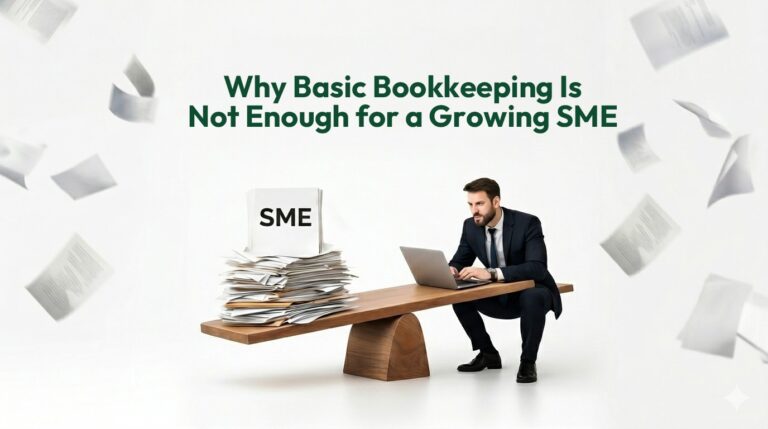
Why Basic Bookkeeping Is Not Enough for a Growing SME
What Does a CFO-Led Outsourced Accounting and Bookkeeping Model Actually Look Like?
A CFO-led finance function gives business owners more than clean records. It gives them visibility, discipline, and better decisions.
Blog Series: CFO-led finance support for growing SMEs
This article continues the discussion on why outsourced accounting should move beyond transaction processing and become a practical management tool.
In the previous article, I discussed what a CFO-led
outsourced accounting and bookkeeping model actually looks like. The key point
was simple: an outsourced finance function should not be limited to recording
transactions. For a growing SME, finance should help the owner understand what
is happening in the business, why it is happening, and what needs to be done
next.
- Clear profit performance (not guesses)
- A real view of cash and working capital
- Fewer year-end cleanups
- Fewer “surprises” from your accountant, your bank, or CRA
This is where many SMEs get stuck.
They have bookkeeping in place. Invoices are entered. Bank
accounts are reconciled. Payroll is processed. HST is filed. The year-end
accountant receives the information and prepares the tax return.
On the surface, everything looks fine.
But when the business starts to grow, basic bookkeeping is
no longer enough.
Bookkeeping tells you what happened. It does not always tell you what it means.
Good bookkeeping is important. Without it, the financial
foundation of the business is weak. But bookkeeping is mainly historical. It
records sales, expenses, payments, receipts, and balances.
What it does not usually provide is interpretation.
For example, a bookkeeper may record that revenue increased
by 18% compared to last month. That is useful information. But the business
owner also needs to know:
·
Was the increase profitable?
·
Did gross margin improve or decline?
·
Did the business need more working capital to
support the growth?
·
Were customers paying on time?
·
Was the increase caused by one large order or a
sustainable trend?
These are not bookkeeping questions. These are management
questions.
This is where a CFO-led outsourced finance model becomes
valuable.
Growth creates complexity.
In the early stages of a business, the owner can often
manage finance through instinct, bank balance, and regular conversations with
the bookkeeper. That may work when the business is small and relatively simple.
But as the business grows, the moving parts increase.
·
More customers.
·
More suppliers.
·
More employees.
·
More inventory.
·
More credit terms.
·
More tax and compliance requirements.
·
More pressure on cash flow.
At that stage, the owner needs more than transaction
processing. They need timely management accounts, variance analysis, cash-flow
visibility, controls, and commentary.
The question is no longer: Are the books done?
The better question is: Are the numbers helping us run the
business?
The monthly accounts should be a management tool.
Many SME owners receive financial statements, but they do
not receive financial insight.
A profit and loss account by itself is not enough. A balance
sheet without review can hide problems. A cash-flow statement prepared once in
a while does not help if cash is tight every week.
A CFO-led finance function should turn monthly accounts into
a decision-making pack.
That pack should explain, in plain language:
·
What happened during the month.
·
Why it happened.
·
What has changed compared to budget, forecast,
or prior month.
·
Where the risks are.
·
What actions should be taken.
This does not need to be complicated. In fact, for many
SMEs, a simple but disciplined monthly finance pack is more useful than a large
report that nobody reads.
Cash flow needs separate attention.
One of the biggest weaknesses I see in SMEs is that cash
flow is treated as an outcome rather than a management discipline.
The bank balance may look healthy today, but that does not
mean the business has control over future cash. Sales may be growing, but
receivables may be increasing faster. Profit may look good, but inventory may
be tying up cash. Suppliers may be stretched, but the problem may not show
clearly in the P&L.
A growing SME needs a regular cash-flow forecast, ideally on
a rolling 13-week basis. It also needs a clear view of collections, supplier
payments, tax obligations, payroll, loan repayments, and expected large
outflows.
This is rarely achieved through bookkeeping alone.
Controls become more important as the business grows.
When a company is small, many things are handled informally.
The owner approves payments. The owner knows the customers. The owner
understands the supplier relationships. The owner can see most of what is
happening.
As the business grows, this becomes harder.
Without proper controls, small issues can become expensive
problems. Duplicate payments, missed customer invoices, poor credit control,
incorrect costing, weak purchasing discipline, or delayed reconciliations can
all affect profitability and cash flow.
A CFO-led outsourced model should help establish practical
controls without making the business bureaucratic. The aim is not to slow the
business down. The aim is to protect it.
SME owners need interpretation, not just information.
Most business owners do not need more reports. They need
better answers.
They want to know whether margins are under pressure,
whether cash will be tight next month, whether pricing needs to change, whether
the business can afford a new hire, or whether growth is being funded by profit
or by working capital strain.
A good outsourced finance team should not only send the
accounts. It should help the owner read the accounts.
That difference matters.
The practical difference
Basic bookkeeping asks: Have the transactions been recorded?
A CFO-led outsourced model asks: Are the numbers complete,
timely, reviewed, explained, and useful for decision-making?
That is the difference between having accounting support and
having financial management support.
For a growing SME, this difference can affect pricing
decisions, hiring decisions, cash-flow planning, bank conversations, investment
decisions, and ultimately the value of the business.
Final thought
Bookkeeping is essential. But it is only the starting point.
As a business grows, the finance function must grow with it.
The owner needs clean books, but also monthly insight, cash-flow discipline,
financial controls, and someone who can connect the numbers to business
decisions.
That is what a CFO-led outsourced accounting and bookkeeping model is designed to provide.
It gives the SME owner a stronger finance function without
necessarily building a full in-house team.
And for many growing businesses, that can be the difference
between simply keeping records and properly managing the business.
SMI Consulting Inc. helps SMEs build disciplined, CFO-led outsourced finance functions — from bookkeeping and monthly reporting to cash-flow visibility and management insight.
- By Syed Irfan- CEO
- No Comments